The story appears finished.
The viewer sees dozens of frames each second, follows the characters' fate, and feels able only to react. The viewer uses the past to predict the next scene and calls that realism.
P · YAHYEL CAPTAIN · HERE AND NOW · TIMELINES
An ordinary person watches a film at normal speed in front of a television. A UFO pilot is the director: the pilot pauses on one frame, lives it completely, and chooses the next. Timelines do not move at the same speed, and the craft reads the pilot's complete intuitive signal rather than step-by-step logic.
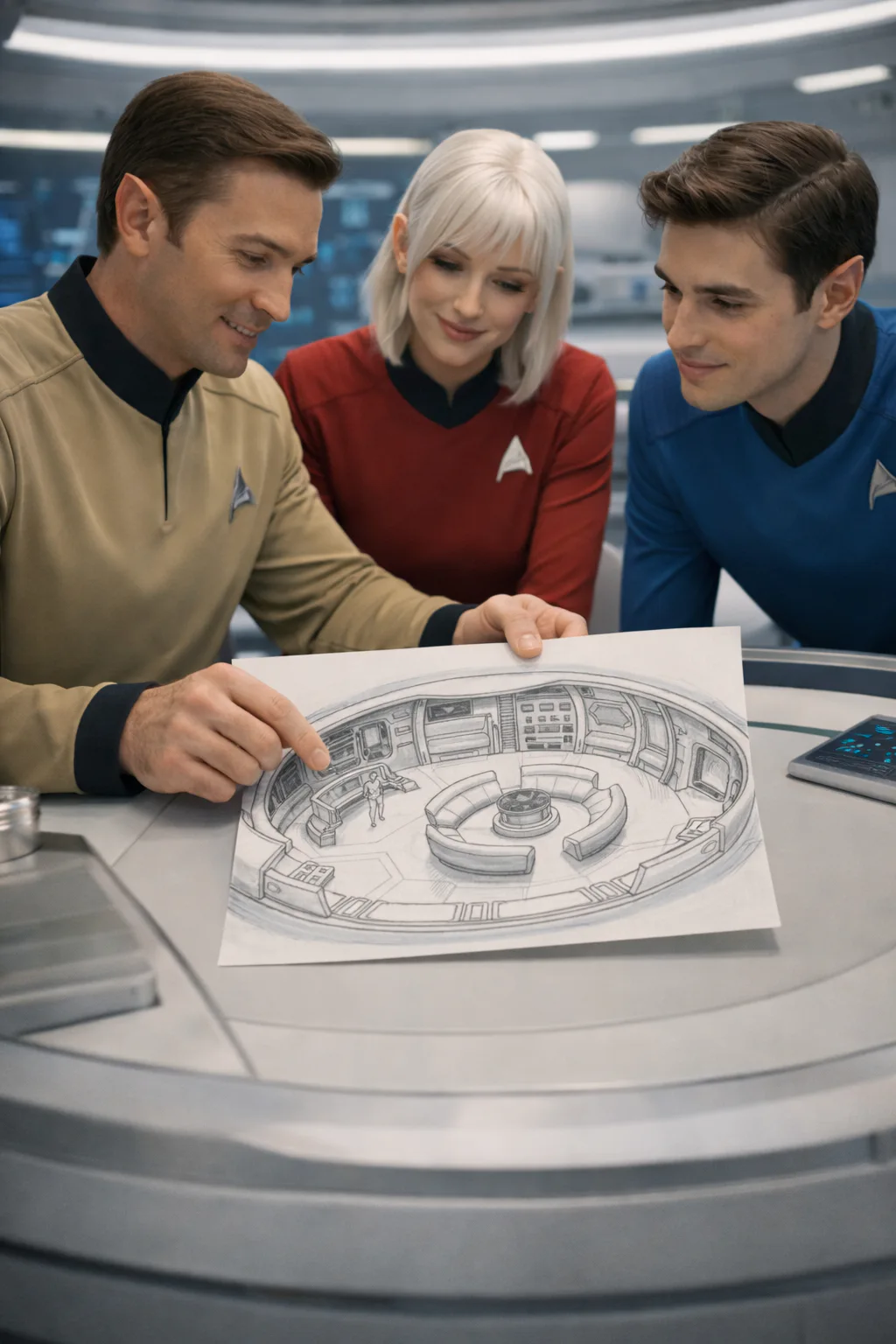
THE PILOT'S CORE SKILL
In this handbook model, a UFO pilot is an operator of consciousness. The pilot does not calculate a journey through a sequence of thoughts. Place, time, timeline, its rate of movement, and frequency are sensed as one whole. That whole is the coordinate.
The Yahyel captain is this page's example. In the author's contact account, the captain did not answer the Lyra question with an entire encyclopaedia; the needed information was made visible as a white, curved, organic craft interior. One question, one relevant information packet, one next frame.
01 · TWO EXPERIENCES OF TIME
The comparison does not say that a human is less valuable. It shows which habit must be relearned in order to move through time and timelines.
| Dimension | UFO pilot · Yahyel captain | Ordinary person in a linear model |
|---|---|---|
| Role | The film's director and editor: responsible for the current frame and the next choice. | A viewer in front of the television: receives the sequence and reacts to what the film shows. |
| Time | Lives in the one usable moment—the here and now. Past and future are accessible coordinates. | Experiences the self as a story moving from past to future and continuously carried forward by the clock. |
| Timeline speed | Knows that timelines move at different speeds. A long experience may unfold in one while only a moment passes in another. | Assumes that one clock and one pace apply to every experience, reality, and layer of consciousness. |
| Navigation | Selects the emotional signature of a place, time, or timeline; the craft finds the matching coordinate. | Crosses distance step by step, waits for time to pass, and treats the destination as separate from the self. |
| Thinking | Does not operate the craft through linear logic. Place, time, timeline, speed, and frequency are sensed together as one intuitive thought packet. | Builds a conclusion step by step and trusts a direction only after the logical mind has calculated it in sequence. |
| Operating mode | Maintains hyper-gamma and a higher-vibration state as a stable baseline: rapid whole-pattern perception, a calm body, and clean focus operate together. | Frequency fluctuates with sleep, stress, fear, sexual energy, and focus; the higher state opens briefly rather than remaining a stable operating mode. |
| Need for a craft | Before becoming a pilot, can move independently between dimensions and realities. A UFO is a car—an amplifier, protection, and shared travel environment, not the source of the ability to travel. | Connects travel with the physical body and an external vehicle, assuming that location or reality cannot be changed without a machine. |
| Memory | Uses memory as an interface formed in the moment. Needed information is reconstructed or arrives for the task. | Treats memory as a permanent archive that proves the past and determines who the person is now. |
| Knowledge | The craft or wider field of consciousness provides the exact thought packet needed for the present task. | Tries to accumulate knowledge, remember everything, and master the whole system before acting. |
| Agreement | A living agreement remains active while every participant chooses it again in the present moment. | A signature given in the past may bind a future person's role, time, and choices even after circumstances change. |
| Coordination | Direct responsibility, tel-empathic transparency, and system compatibility replace central bureaucracy. | Laws, licences, regulations, and institutions decide what may be done and who may act. |
| Feedback | An incompatible intention creates immediate incoherence: the craft, crew, or timeline does not align with the choice. | Consequences often arrive later through external control, an enforcement process, or punishment. |
02 · THE FILM-FRAME ANALOGY
At normal speed, a film blends separate frames into an apparently continuous story. In the same way, a linear person may believe that the previous scene automatically forces the next one to happen.
The viewer sees dozens of frames each second, follows the characters' fate, and feels able only to react. The viewer uses the past to predict the next scene and calls that realism.
The director pauses on one frame and gives it complete attention: light, sound, the actor's intention, and the direction of the scene. The previous frame is not denied, but it no longer controls the console. The next one can be changed.
The physical layer is slower and more inert, while reflection may change faster in higher layers of reality. A time-machine coordinate is therefore not only ‘where’ and ‘when.’ The pilot also senses the rate at which the chosen timeline unfolds events.
Change passes through the body, matter, and sequential events. By the physical clock, the film can advance only frame by frame.
A long experience, encounter, or period of learning may fit inside one moment of physical clock time. On return, the two timelines may not show the same elapsed time.
Place + time + timeline + rate of time + frequency form one whole. The wrong rate means the wrong coordinate even when the date appears correct.
04 · BEFORE BECOMING A PILOT
In this handbook model, a UFO does not give a being the ability to move between dimensions. A craft is like a car: it extends range, stabilizes the journey, protects the traveller, and carries a crew, home, and equipment together. The ability to move belongs to consciousness itself.
If a being reaches another reality only through a craft, that being is still a passenger. Before operating a craft, a pilot must independently find the destination frequency, hold focus, move there, and return. Only then does the UFO amplify an existing skill.
In the handbook model, one consciousness can be in several places at once: the physical body acts here, a dream or astral self is elsewhere, and another viewpoint is present in a parallel reality. A person can preserve this ability when growing up with the knowledge that it is possible and keeping sexual energy, mental health, and focus sufficiently healthy. Sexual energy is neither leaked blindly nor frozen; it is preserved and directed as life force.
Before the craft, only one core skill is learned: can consciousness independently find another reality, remain conscious there, and return? If yes, the UFO is a car. If not, the person is still a passenger in the car.
05 · MEMORY AND DOWNLOADED INFORMATION
In the handbook model, memory is not a shelf on which an entire life is stored unchanged. Present state, belief, and the chosen timeline help translate the past anew each time.
A memory image is a version reconstructed in the present, not a physical object from the past carried inside the head.
A pilot does not need to remember every craft, era, or timeline. The task calls forth the matching thought packet, map, or skill.
Knowledge is a usable connection, not a status. When the frame changes, so may the information that needs to be accessed.
This does not mean that memory problems in everyday life should be ignored. The analogy describes the handbook's consciousness model; health and safety questions still require verifiable information and appropriate help.
06 · LIVING AGREEMENTS
If a pilot moves through different times or timelines each day, carrying the laws, licences, and contracts of one era along would become contradictory. A rule belonging to one society and one historical situation cannot automatically become a universal command governing all movement beyond time.
For that reason, this civilization model has no central governmental bureaucracy that binds a pilot's or resident's future self to a past promise. An agreement is living: precise, transparent, and voluntary, but only while the participants choose it now.
07 · THE YAHYEL CAPTAIN EXAMPLE
In the dream contact described in October 2025, the author used the Yahyel symbol as a contact address, met a captain, and asked about Lyra. The answer took the form of a spatial image: the captain drew a white, curved, organic UFO interior.
For this page, the form of the answer matters. The captain did not have to review all of Lyra's history or prove a rank. The captain focused on the active frame of the question and made available the information needed for the next step.
OPEN THE YAHYEL CAPTAIN CONTACT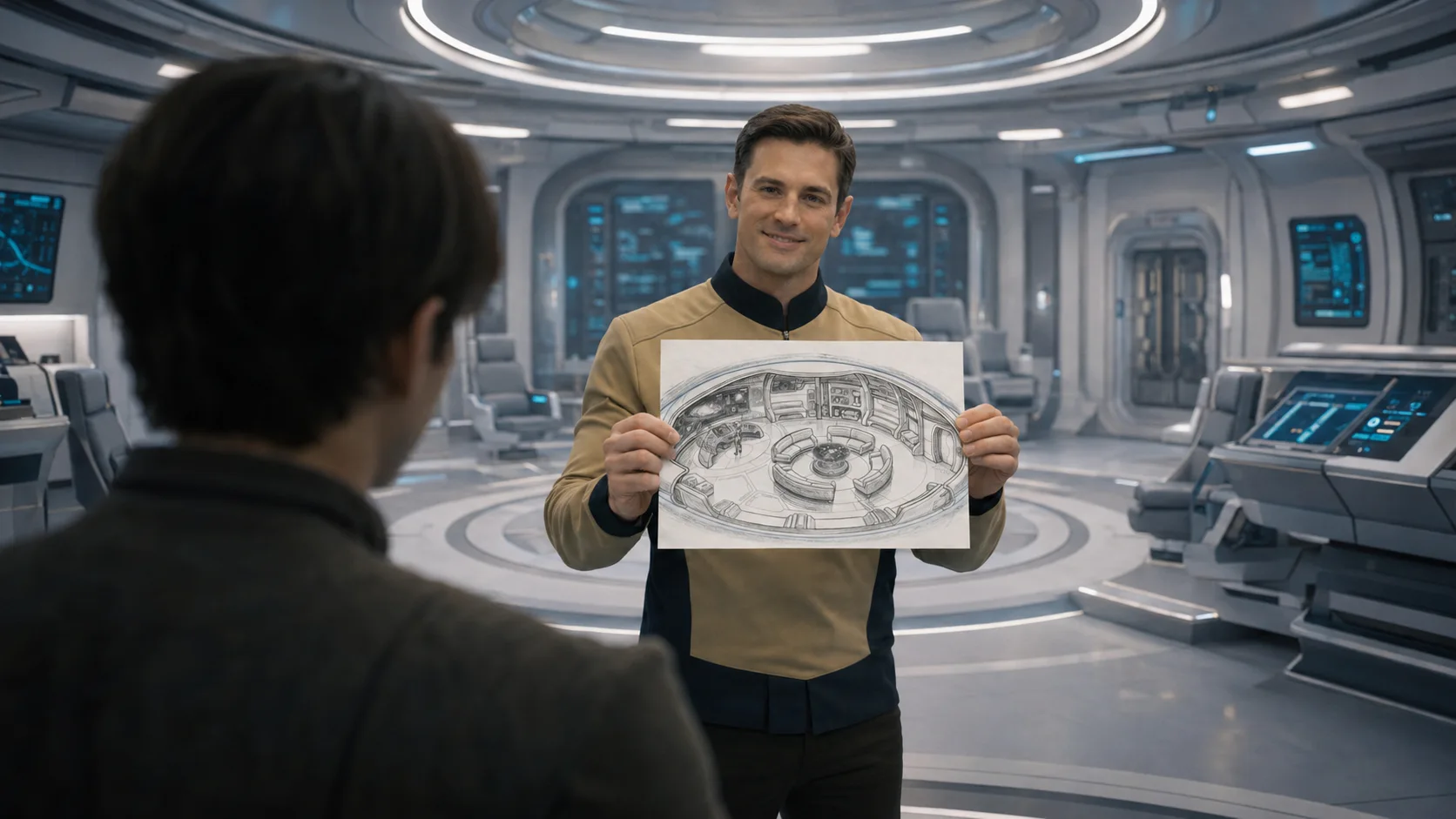
08 · FROM INDIVIDUALITY TO MULTIDIMENSIONALITY
Do not focus on individuality as your entire identity. Name, body, life story, personality, and sequential memory are the user interface of one physical viewpoint. The pilot focuses on the multidimensional consciousness that existed before the present body and can be connected to several lives, places, realities, and timelines at once.
The body is neither a prison nor an enemy. It is the local cockpit of the present frame. Multidimensionality means that the larger self contains this body, not that the body should be abandoned. Caring for the physical viewpoint keeps the pilot's connection clear.
The pilot does not operate the entire universe or other people. The pilot operates the personal micro-universe: the belief, definition, emotional direction, attention, energy, and action that the soul sphere reflects back as the next experience.
Responsibility means one simple thing: if you chose the direction of the next frame, you also read the result and deal with the consequence. You do not make a craft, contact being, government, the past, or the universe the author of your choice. You do not operate another person's reality; a shared reflection forms only where both choices overlap.
A pilot's freedom does not come from a craft or permission. It begins with recognizing the self as multidimensional consciousness, listening to the complete intuitive signal, stabilizing hyper-gamma and higher vibration, and living one frame completely. The pilot chooses the reflection of personal reality and takes responsibility for the next frame.