Children up to age seven
Accounts of invisible friends, souls and auras raise the question of how adults respond to what a child says.
K · MÄNNI PARK · SOUL · PERCEPTION · BELIEFS
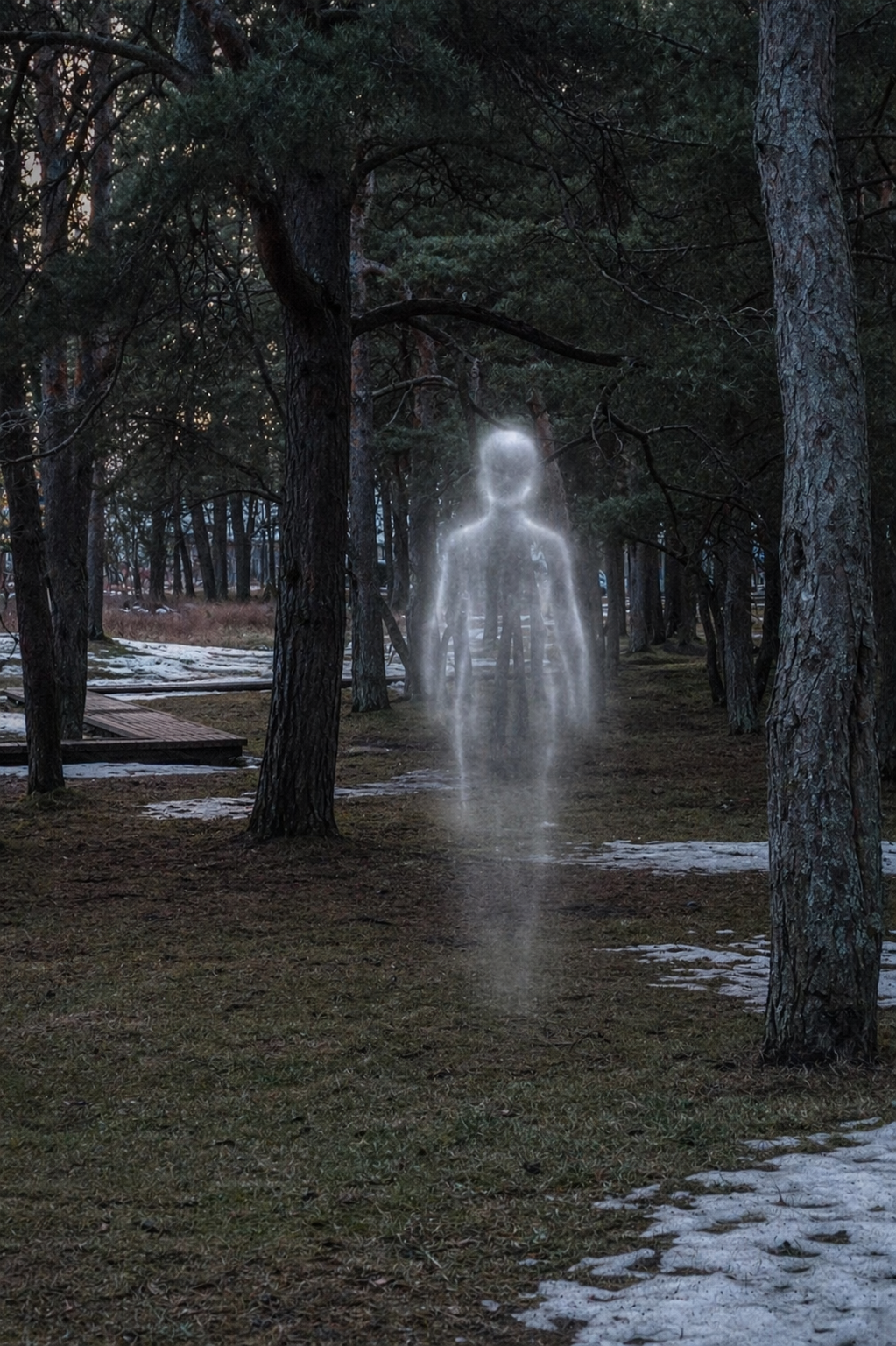
The ghost of Männi Park raises a question: does an experience feel strange because of what you noticed, or because of what you were taught to fear?
01 · THE GHOST OF MÄNNI PARK
This page begins with the ghost motif in Männi Park. The image shows a familiar park, pine trees, snow and a translucent human figure. The word ‘ghost’ immediately gives that figure a story: fear, the unknown, or a question about the soul.
In the handbook's spiritual perspective, a ghost is understood as a soul whose perception need not begin with fear. The teaching focuses on a person's relationship with their experience: can it be described calmly, or must it immediately become a source of shame?
02 · EXAMINING A BELIEF
For this teaching, a limiting belief is the idea that an unfamiliar experience must be forbidden before it has been heard. When someone speaks of a soul, an aura or an invisible friend, the conversation can begin with ‘What did you notice?’ rather than ‘Something is wrong with you’.
Respecting an experience does not require everyone to agree with its explanation. You can listen, take the person's feelings seriously and leave the meaning of the experience open.
03 · CHILDHOOD AND ENVIRONMENT
In the handbook's model, the first seven years are a period when a child learns from their environment which experiences may be noticed and shared. Perceiving souls and auras is connected here with staying open to experience or beginning to push it aside to gain others' approval.
This choice need not mean a conscious decision made on a birthday. In the teaching it describes repeated adaptation: is my experience heard, or do I learn to keep quiet about it? Seven years is not an established age limit or an irreversible decision determining perception for life.
Accounts of invisible friends, souls and auras raise the question of how adults respond to what a child says.
The teaching compares childhood with accounts of sensing souls or a presence near the end of life. This is a spiritual comparison, not a rule applying to everyone.
In some people's own accounts, such experiences accompany them throughout life. A different experience is not in itself a reason to ridicule someone.
04 · A PARENT'S RESPONSE
‘Don't talk to invisible friends; it's strange’ may express an adult's own fear or discomfort with the unknown. The handbook's message to parents is simple: do not turn the limits of your own perception into a compulsory worldview for your child.
A calm response might be: ‘Tell me what you noticed. How did you feel?’ Listen without shaming and without telling the child who or what must be behind the experience. A child does not have to confirm your belief or prove anything to you.
05 · A LESS FEARFUL RELATIONSHIP WITH PERCEPTION
The teaching asks a pointed question: why is suppressing an experience sometimes treated as natural, while speaking about it is treated as strange? If someone learns to stay silent solely to avoid judgment, they at least limit their freedom to explore and describe their experience.
Not seeing souls or auras does not make someone abnormal. Freedom also includes the right not to see, not to seek and not to agree with the same interpretation. The aim is to reduce shame and pressure, not to impose a new requirement that everyone perceive things alike.
Do not let fear decide what may be discussed. Listen to the experience, examine the interpretation and leave room for choice.