drama · concealment algorithm
Roswell: The U.F.O. Cover-Up
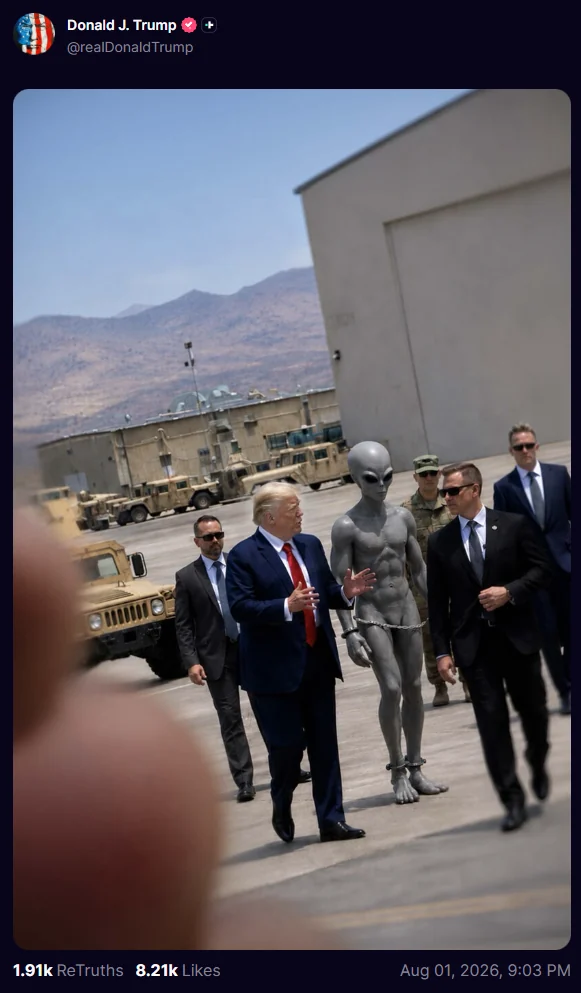
Near the end of the film, generals discuss the Roswell incident, a possible being, technology, and public reaction. Their solution is not merely silence, but control over how information emerges.
Transcript: 01:12:07–01:14:42
- Check the method and timing of disclosure, not only the secret itself.
- Mix possible leaks with deliberate disinformation and fraud.
- Allow precise information to appear through channels that the public considers unreliable.
The scene shows how concealment can work even when some information leaks: the public must lose the ability to distinguish accurate material from fraud, staging, and an unreliable intermediary.
The Alien Teachings interpretation: true information may be publicly visible within a film or low-credibility channel yet remain socially unusable because its status is deliberately unclear.Film information: IMDb ↗
Claim, testimony, and source
Ask who is speaking, what they personally saw, which source material is public, and which conclusion was added during editing.
Cultural test laboratory
Ask what kind of contact, fear, institution, and human role the story normalizes—not whether the plot is documentary fact.
fiction · disclosure and perceptual mimicry
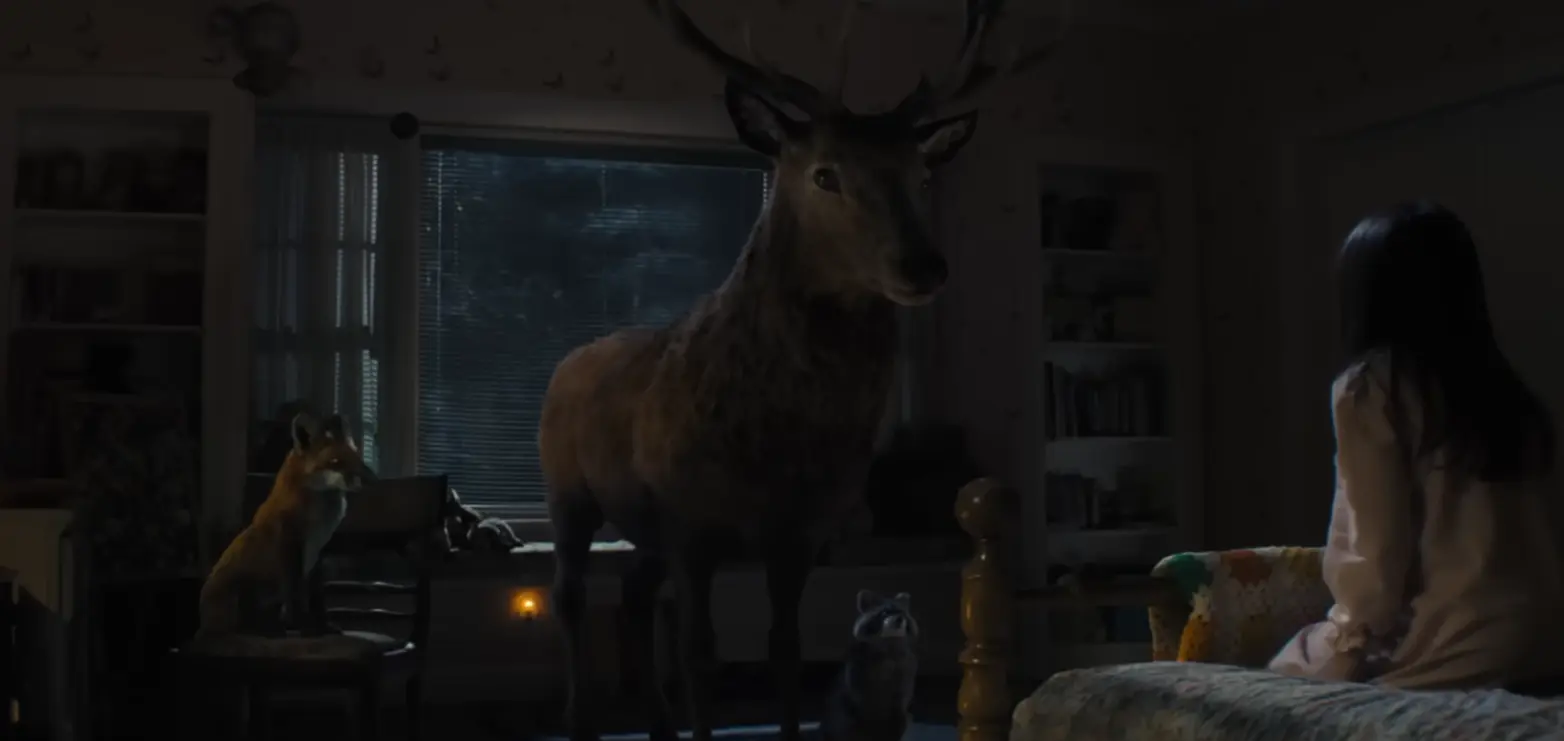
Disclosure Day · why might contact appear in animal form?
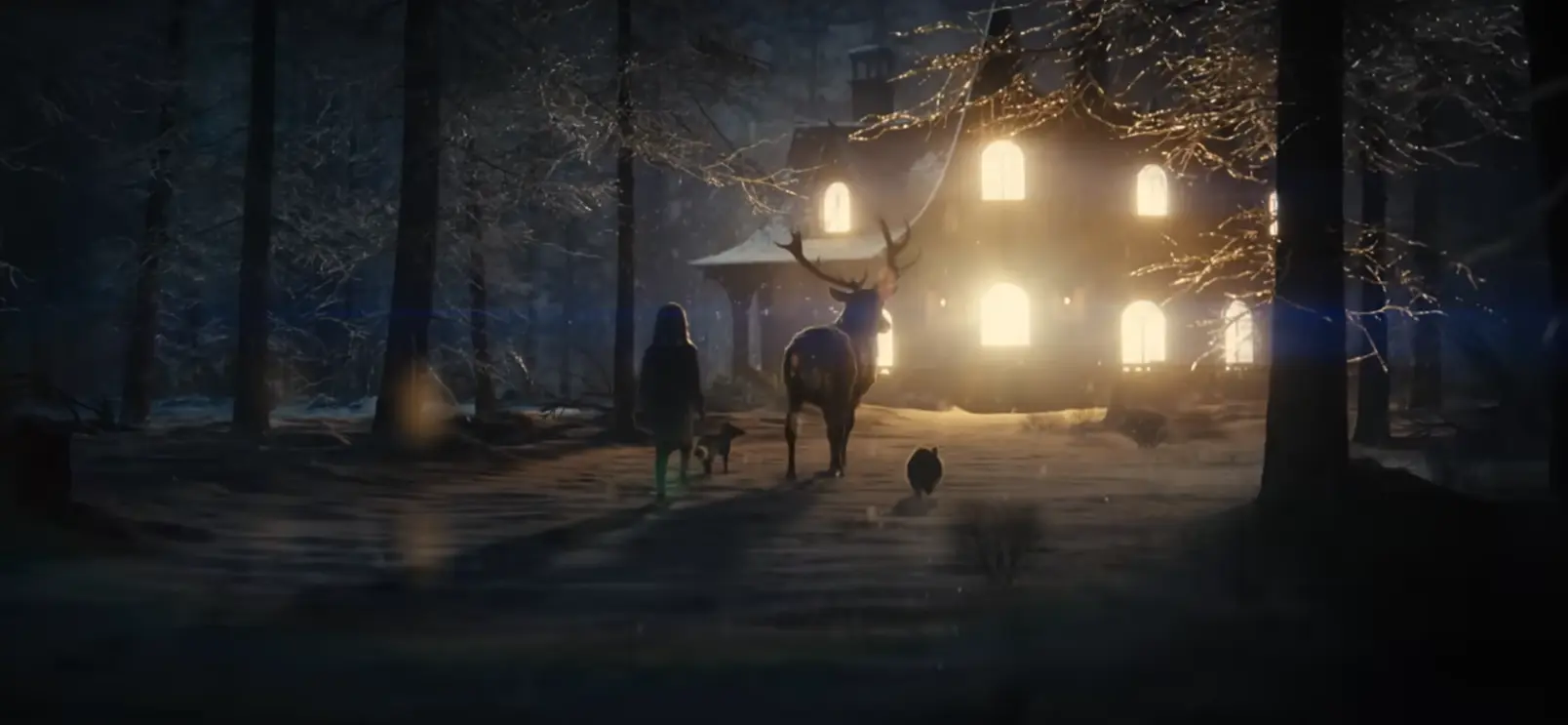
The film's animal imagery offers a visual comparison for why, in this project's model, many contact experiences may begin in animal form: at first, a person may not see the unknown presence in its original anatomy, but as a deer, fox, raccoon, or another familiar life form.
In the Alien Teachings model, a being may use the viewer's third-eye image-generation mechanism together with ego beliefs and memory to reduce shock. An animal form acts as a temporary visual interface until the person can perceive a less familiar original form more calmly.
Context is missing
The person does not yet have a stable internal model of the being's original anatomy, movement, or facial expression.
The brain chooses a familiar form
An unknown signal is associated with a deer, fox, raccoon, or another animal whose dimensions and behavior a person already knows.
A more precise form may open later
As fear decreases and context about the being develops, the visual translation may become more detailed. The first image is not treated as final anatomical evidence.
USE OF THE FILM IN THIS HANDBOOK
Use these frames to explain mimicry: when a person lacks context for the appearance and behavior of space beings, the brain gives the unknown a readable form from its existing visual library. The first image may therefore describe the mode of contact rather than the being's final physical form.
INTERPRETATION BOUNDARY
This is the Alien Teachings project's way of reading the film, not a claim about the filmmaker's official intention or proof that every animal sighting is contact. Ordinary explanations must be checked first; the mimicry model is used when other contact characteristics also recur in the experience.
03–04 · TWO CONTACT ALGORITHMS
Galactic society and normalization of the Grey
These two works do not serve the same role. One trains us to make sense of an interspecies society; the other reduces automatic fear of a Grey being.
film and television universe · galactic society
Star Trek
Star Trek creates an extensive comparison model involving the histories of different civilizations, the Federation, first-contact rules, diplomatic boundaries, and cooperation among multiple species on the same ship.
Use this as a comparative frame for making sense of Yahyel and galactic history—not as a direct depiction of Yahyel, but as a question about which norms allow different species to operate together in space.
Project perspectiveObserve conduct in space: chain of command, consent, limits of intervention, translation, diplomatic protocol, crew responsibility, and the consequences of using force.
More information: Star Trek ↗comedy · normalizing a Grey being
Paul
Paul takes the Small Grey out of the position of horror, secrecy, and sacred symbol, and turns him into a character with mistakes, humor, opinions, and everyday needs.
Humor reduces automatic fear and lets the audience imagine a Grey as a fellow traveler and a personality, not only as an abductor, experimenter, or military object.
Project perspectiveThis is not a contact protocol. Its value lies in normalization: a different body does not preclude character, relationships, loyalty, or ordinary cooperation.
More information: Universal Pictures ↗ADDITIONAL COMPARISONS
Seven more films and series to watch with a specific question
The selection is not a ranking of the ‘best UFO films.’ Each work represents a different disclosure or contact problem.
documentary · institutional claim
The Age of Disclosure
Claims by former and current US government, military, and intelligence officials about long-term secrecy and a technological arms race.
View this as an example of the political narrative of disclosure, not a substitute for physical evidence.More information: Prime Video ↗
documentary · history of cases
The Phenomenon
Postwar UFO history, witnesses, archival material, and a call to investigate the phenomenon more seriously.
Use it for cross-comparison: which motifs recur at different times, and which claims remain unverified?More information: Apple TV ↗
documentary series · experiencer stories
Encounters
Mass sightings in several regions, witnesses' experiences, and their social aftermath.
Compare the event, later interpretation, and community reaction separately.More information: Netflix ↗
film and television universe · international and interspecies cooperation
Stargate
Stargate depicts a classified gate program that develops into cooperation among different countries and partnership with the Asgard—a race resembling Small Greys—and other spacefaring races.
Use this as a model for international contact cooperation: countries must share responsibility, establish common rules, and learn to distinguish allies, neutral parties, and hostile forces without classifying every different being as a single threat.More information: MGM ↗
fiction · language and timeless perception
Arrival
Contact fails or opens according to how language, intention, and a nonlinear perception of time are translated.
The most direct cinematic comparison with the themes of the thought packet, translation loss, and timeless contact.More information: Paramount Pictures ↗
animated film · cosmic history and spiritual teaching
The Laws of the Sun
Through its religious cosmology, the film presents Earth's history as a long hybridization program in which repeated interventions by extraterrestrial civilizations influence the development of human groups.
View this as a cross-comparison, not as historical evidence. For the project, the central image is one of self-love drawn from Buddhist thought: grow the inner light and share it with others like the sun, without surrendering your authority to the film's worldview.More information: Happy Science · official full-length film ↗
fiction · symbol, sound, and contact ritual
Close Encounters of the Third Kind
A recurring inner image, musical communication, state secrecy, and a room prepared for a physical meeting.
See how the film shaped the collective image of benevolent contact and the chosen contactee.More information: Sony Pictures ↗
VIEWING PROTOCOL
Do not ask only ‘Is it true?’
These six questions turn a film from entertainment into an analysis of a social contact algorithm.
Who controls the information?
The state, military, scientist, contactee, media, or the alien itself?
What is the first automatic reaction?
Attack, concealment, investigation, dialogue, or cooperation?
How does communication occur?
Language, sound, symbol, thought packet, dream, technology, or physical meeting?
Where does translation loss occur?
Is the danger observable behavior, or a story added by human fear?
What kind of person can become a bridge?
A soldier, scientist, child, experiencer, diplomat, or ordinary citizen?
What does the film normalize?
The existence of aliens, a state secret, cooperation, invasion, or a change in human consciousness?
THE POSITION OF ALIEN TEACHINGS
Disclosure is not a single sentence from a president.
This is a change in the collective translation algorithm: the unknown can be observed, discussed, and imagined as a partner in cooperation without an automatic template of invasion, salvation, or ridicule. Film helps rehearse this change, but contact competence develops only through real choices.
BACKGROUND & CONNECTIONS
Films provide a vocabulary for contact before society knows what to ask.
A film scene does not replace personal experience, but it can unlock an image, an ethical question, or a thought packet for which there previously were no words.
THE ACTUAL TEACHING
Arrival shows that contact begins with building a shared language rather than seizing unfamiliar technology. Star Trek offers images of a federation, first-contact ethics, and cooperation between species. Films help with comparison, but a film's events must remain clearly distinct from personal contact.
Disclosure is not limited to whether other beings exist. It changes how we understand cooperation, consciousness, the use of technology, responsibility, and who gains access to new possibilities.
THE STORY AND CONTACT CONTEXT
In the handbook, the eight foundational encounters work like the separate message fragments in Arrival: the Grey provides awakening, Lyra the bodily teaching, the Yahyel a communication key, the Mantis timing, and the Tall White responsibility. No single fragment explains the whole system.
In the health manuscript, the series Taken offers a parallel for a consciousness-linked spacecraft: the supposed engine may not be a separate metal component but the relationship between the being, the body, and the technology. Preparing the body therefore also becomes a technology question.